
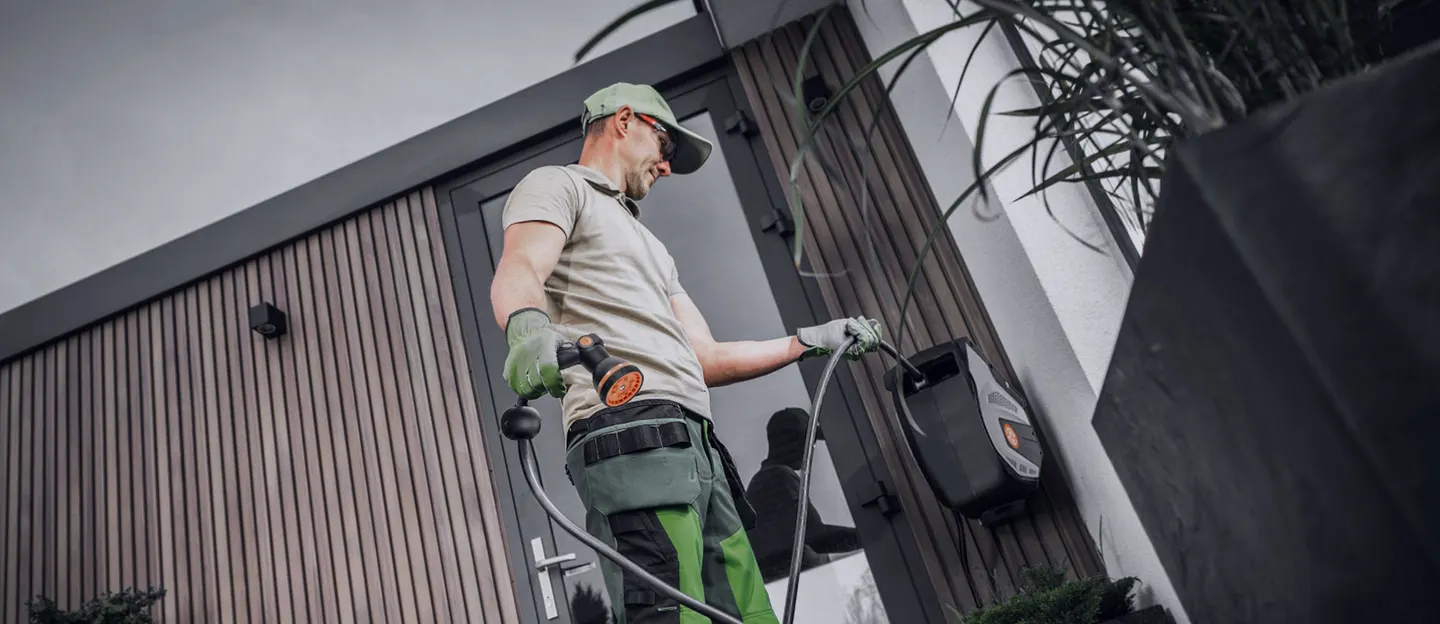
A garden hose is cheap. A garden hose left on the lawn is expensive: it kinks, cracks in the sun, gets run over by the mower and trips someone carrying groceries in the dark. A wall-mounted reel that winds the hose back by itself fixes all of that, as long as you choose the right length and hang it in the right place. This guide covers both, plus the watering and winter care that keep a hose working for years.
How a retractable reel works
Inside the housing, a spring winds as you pull the hose out. A ratchet lets you stop at any length, and the hose stays there. When you are done, you give it a short tug to release the lock, and the spring winds the hose back in. A guide at the mouth of the reel lays the hose across the drum so it does not bunch up on one side.
On our 1/2 in reels in 100 and 150 ft, the rewind is slowed on purpose, so the hose does not whip back across the yard. On every SUNPOW reel, the bracket swivels 180°, so one reel on a corner wall can water beds on both sides of the house.
Measure the run before you buy
The most common mistake is buying a reel by guessing. Take a tape measure or a long string, start at the faucet and walk the path the hose will actually take: around the corner of the house, along the fence, past the patio furniture. Stop at the farthest spot you will water. That number is your run.
Then add a margin. You need some slack to reach around a bed rather than drag the hose across it, and the hose has to make the turn from the wall. About 10 ft on top of the measured run works for most yards. Our reels come in 33, 50, 65, 85, 100, 115 and 150 ft, so round up to the next length.
| Your measured run | Pick at least | SUNPOW reels in that length |
|---|---|---|
| Up to 20 ft (patio, balcony) | 33 ft | Lightweight 1/2 in reel |
| 20 to 40 ft (small yard) | 50 ft | Heavy-duty 1/2 in reel |
| 40 to 55 ft | 65 ft | 5/8 in long-reach reel |
| 55 to 75 ft | 85 ft | Heavy-duty 1/2 in reel |
| 75 to 90 ft | 100 ft | 1/2 in slow-retract or 5/8 in reel |
| 90 to 105 ft | 115 ft | Heavy-duty 1/2 in reel |
| 105 to 140 ft | 150 ft | 1/2 in slow-retract reel |
Longer is not always better. A longer hose holds more water and loses more pressure along the way, and the reel itself gets heavier. If your run is 40 ft, a 150 ft reel will mostly sit full on the wall. Our home page has a slider that does this arithmetic for you and points at the matching reel.
Half-inch or five-eighths hose
Hose diameter is the inside width of the hose. A wider hose carries more water at the same faucet pressure, which you notice with a sprinkler, a pressure nozzle on the car, or a long run to the far end of the yard. A narrower hose is lighter to pull, coils more compactly and fits more length into the same reel housing.
Across our range, 1/2 in hose goes up to 150 ft and 5/8 in comes in 65 and 100 ft. For most yards and hand watering, 1/2 in is plenty. Choose 5/8 in if you run a sprinkler at the end of a long hose or wash cars and patios often.
Fittings and the leader hose
The reel connects to the faucet with a short leader hose. On every SUNPOW reel, that connection is a 3/4 in brass fitting, the standard garden hose thread used on outdoor faucets across the United States. Brass holds its thread far longer than plastic, which matters on a connection you tighten and loosen every spring and fall.
Before the first use, check that the rubber washer sits flat inside the fitting. A missing or twisted washer is the reason behind most drips at the faucet. Hand-tighten the fitting, then give it a small extra turn. Tools are rarely needed and can crush the washer.
Pressure, patterns and what a reel will not change
A reel stores and protects the hose. It does not change the water pressure you get from the faucet. If the flow at the end of the hose is weak, look at the faucet, the length of the run and the width of the hose before you blame the reel. A shorter run and a wider hose both deliver more water at the nozzle.
The nozzle decides how that water lands. A jet pattern is for washing the car or blasting mud off a patio. A shower or flat pattern waters a lawn or a wide bed evenly. Mist is for seedlings and hanging baskets. Our ten-pattern nozzle switches between them with a twist and a click, so one nozzle covers the whole yard.
Where to mount the reel
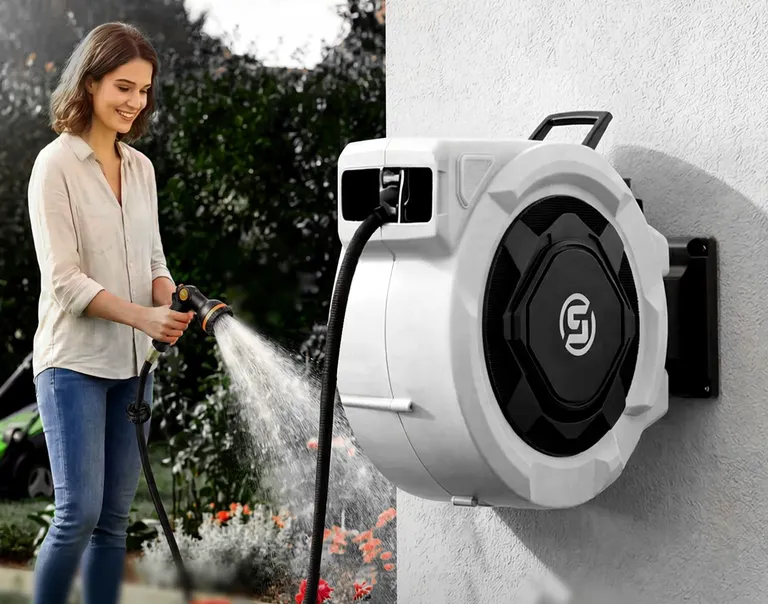
Mount the reel on a solid wall, close to the faucet, at a height that lets you pull the hose out at waist level. Brick, concrete and solid wood framing hold the bolts well. Hollow siding and thin panels do not, so find a stud or use a backing board. Our reels ship with a wall bracket, bolts and expansion tubes, four or five depending on the model.
- Pick the wall, within reach of the faucet, where the hose can swing to both sides of the yard.
- Hold the bracket level against the wall and mark the holes with a pencil.
- Drill the holes, tap in the expansion tubes and fix the bracket with the bolts from the box.
- Hang the reel on the bracket and connect its leader hose to the faucet through the 3/4 in brass fitting.
- Pull out a few feet, let it lock, then tug to check the rewind before the first watering.
Set the reel so the outlet points along the wall rather than straight out. With the 180° swivel, the hose then turns smoothly to either side instead of rubbing against the corner of the housing.
Watering: how much and when
A reel makes watering easier, which means it also makes overwatering easier. University extension services agree on a simple target for lawns. North Dakota State University puts it this way:
“To keep your lawn green and growing, it needs about 1 inch of water per week from you, rainfall or a combination of both.”
Cornell's College of Agriculture and Life Sciences adds advice on timing:
“The best time to water is from 4 am to 8 am.”
Early water soaks in before the sun is high, and the grass dries during the day, which lowers the risk of disease. A short sprinkle every evening wets only the surface and trains roots to stay shallow. Fewer, deeper waterings do more good. To check how long your sprinkler takes to put down an inch, set out a few flat-bottomed cups and time it.
For beds and pots, the nozzle matters more than the hose. A soft shower or mist pattern waters seedlings without washing soil off their roots. A jet pattern is for cleaning, not plants.
Care through the seasons
Most hose damage happens in two seasons. In summer, sun and heat break down hose left lying out. A reel solves that by keeping the hose wound in the shade of its housing. In winter, the danger is ice.
Water expands as it freezes. The University of Illinois Extension explains what happens when a hose stays connected through a cold snap:
“If you leave the hose attached to the spigot, water may remain in the line and as ice forms, it can progress back into the spigot and perhaps into the house.”
Mississippi State University Extension gives the routine in one line:
“Unhook garden hoses from outdoor faucets. Drain them, roll them up, and store them indoors.”
With a wall-mounted reel, that means a short job each fall. Turn off the faucet and disconnect the leader hose. Pull the hose out fully and let it drain, ideally downhill. Let it wind back in, then take the reel off its bracket and store it in a garage or shed. Cover the outdoor faucet before the first hard freeze.
When the hose will not lock or rewind
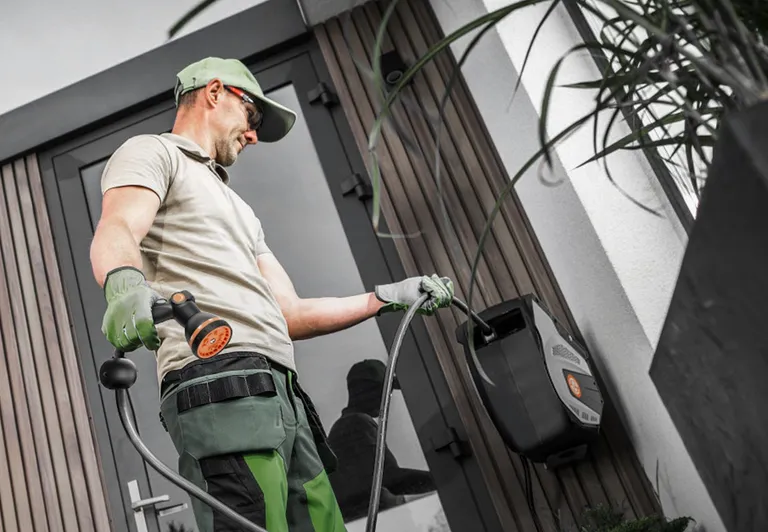
Nearly every problem with a retractable reel comes down to how the hose is pulled. The lock catches when you pull and then stop. The rewind starts when you pull a little further and let go. If the hose rewinds when you want it to stay, you probably pulled too far past the catch. If it will not lock, pull more slowly and stop cleanly.
Always turn the nozzle off and let the pressure out before rewinding. A pressurized hose is stiff and fights the spring. Walk the hose back toward the reel rather than letting it fly, which is easier on the guide and on anything standing in its path.
If water leaks at the faucet, the washer in the 3/4 in fitting is the usual cause. Replace it, hand-tighten the connection and give it a quarter turn more.
Living with a reel day to day
A few small habits keep a reel running smoothly. Pull the hose out in a straight line from the mouth of the reel instead of at a sharp angle, so it does not rub on the guide. Let it wind back while you walk beside it. Wipe off mud before it goes in, because grit on the hose wears the guide over time. And once a season, pull the hose all the way out on a dry day to check for cuts or soft spots.
If you have young children, show them that the hose comes back on its own. A hose that rewinds unattended can surprise a small child, and it is easier to teach the rule once than to untangle a tearful moment later. The slow retraction on our 1/2 in 100 and 150 ft reels helps here, but walking the hose back is still the best habit.
Which SUNPOW reel for which yard
- A patio, balcony or short front bed: the 33 ft lightweight reel.
- A typical back yard: the heavy-duty 1/2 in reel in 50 or 85 ft.
- A long yard or a run to the driveway: 115 ft heavy-duty, or 150 ft with slow retraction.
- A sprinkler at the end of a long run: the 5/8 in reel in 65 or 100 ft.
Whichever you choose, measure first, mount it on something solid, and drain it before the frost. A reel looked after that way will outlast several hoses left on the lawn.
Sources
- NDSU Extension (North Dakota State University), “The Right Way to Water Your Lawn”, read online, read October 28, 2026
- Cornell University, College of Agriculture and Life Sciences (NYS IPM), “Watering your lawn”, read online, read October 28, 2026
- University of Illinois Extension, “How to winterize outdoor plumbing - irrigation, hoses, spigots (Good Growing blog)”, read online, read October 28, 2026
- Mississippi State University Extension, “Tips to Winterize Your Home”, read online, read October 28, 2026